Showing posts with label Forsythe. Show all posts

Saturday, March 3, 2012

Ein William Forsythe Ballettabend

by Angela Incampo & Ralf Lippold

The Premiere, and so just one performance, of 'Ein William Forsythe Ballettabend' at Semperoper was not enough. A new attendance as a follow-up performance was needed to understand and appreciate the choreografies created by the great choreogrepher Forsythe, and brought on stage by an always incredible ballet company, such as the Semperoper Ballet truly is. Everybody probably knows that Aaron S. Watkin is a former Forsythe dancer, and therefore more than every other ballet director can understand the difficulties, the efforts, and the great concentration these pieces require.

In a completely full theater (so full has been the Premiere as well) the music starts and the curtain rises. On stage the whole company starts with "Artifact Suite" a piece already performed to Semperoper's audience last spring in 2011 within a variation rich, and not thematic programme. Last spring the ballet company was asked to dance a classical piece (George Balanchine - 'Emeralds'), and two modern pieces (Mats Ek - 'She was black', and William Forsythe - 'Artifact Suite'). In this occation, the Ballett Company proved again their ability to switch from a classical piece to a modern piece and the dancing maturity they are capable to put on stage (for more information, here the relevant links to the articles). Not many companies are able to perfectly combine the movements typical of classical dance with those required by modern dance.

Photographer: Costin Radu
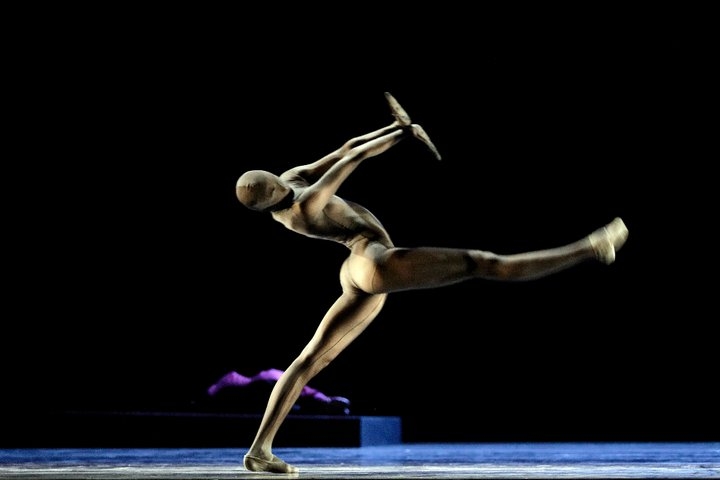
"Artifact Suite" on music by Eva Crossman-Hecht and Johann Sebastian Bach, is an extremely beautiful piece. The green-coloured costumes of all the dancers are interrupted by the white-coloured suit of one single dancer, Vanja Vitman. She is the guide, she controls all movements of the Corps de Ballet and sometimes also the two dancing couples performing the pas-de-deux (Elena Vostrotina with Oleg Klymyuk, and Yumiko Takeshima with Raphäel Coumes-Marquet). She is the master who "leads the puppets", helped by a big lightspot. She decides when they have to move, and when they have to stand moveless. Homogeneity and heterogenity are both performed. The whole ballet company is involved in this huge choreography. The lack of coordination among the dances in some scenes and the strong coordination in other scenes are wildly interrupted by the curtain falling continuosly down. Is what we see performed on stage, the lack of co-ordination we experience in our daily life as personal individuals, and as members of the society? Is it a clear sign of the difficulties we always meet? A smooth life, with the different seasons coming quietly one after the other finds no room in today's human life. Also the movements, sometimes so slow and sometime so fast, mirror the current times.

Photographer: Costin Radu
William Forsythe has created and new arranged, expressly for the Semperoper Ballet, the second piece "New Suite". On music by Georg Friedrich Händel, Johann Sebastian Bach, Luciano Berio, Gavin  Bryars, Thom Willems are brought on stage, one after the other, seven couples (Chantelle Kerr* with Claudio Cangilosi*, Elena Vostrotina with Oleg Klymyuk, Julia Weiss and István Simon, Anna Merkulova and Jiří Bubeníček, Duosi Zhu and Pavel Moskito, Yumiko Takeshima with Raphaël Coumes-Marquet, Anna Merkulova and Jón Vallejo). The costumes, for this second piece are plain and perfectly co-ordinated between the dancing couples. No curtain falls down to interrupt the scene. The stage is completely free. They can perform in an open-space, in movements of pure harmony and disharmony, shaping the relationship between the sexes, expecially on Berio's music.

The third and last piece is "Enemy in the figure". The whole choreography is illuminated by a big spotlight free to be moved around on stage (a main figure on stage, as it gives more or less emphasis to the scene). The spotlight is continuously moved around by the dancers according to their internal needs. A rope cuts the stage in two and so does also a wavelike wooden wall, that "hides" the sight on what's happening behind it. Depending on the position in the audience, one gets a totally different picture of the scene, and what is visible from one side, appears invisible from another position. Very much in flow with reality, that can differ vastly from your own position, and perspective - seeing reality is not what one sees on the surface.

Photographer: Costin Radu
The dancers (Chantelle Kerr*, Raquel Martinez, Anna Merkulova*,  Ana Presta, Elena Vostrotina, Julia Weiss, Jiří Bubeníček*, Claudio Cangialosi, Raphaël Coumes-Marquet, Maximilian Genov*, Fabien Voranger) wear totally white, totally black or white and black (pierrot-like) costumes. Looking at the dancers moving on stage and hearing the rough music, the viewer can physically feel the dichotomy on stage. The dancers movements are strong. They cut through the air like sharp knives, they seem forced to move by some unseen force, acting like under fever. They restlessly try to free themselves from a force that is hosted inside themselves, deep in their bodies, and in their souls. Their fast movements show the need to re-create the lost balance, the harmony between all parts. The elements on stage (rope and wooden wall) are a clear further sign of the dichotomy the dancers are living in. All metallic and rough sounds, the dissonances are created ad hoc - very strongly in need!

Also in this piece the difficulty to live a quiet life can be seen; the forces that move our souls and our bodies, and that keep us away from acting in free-will. The desperate search for peace in all different moments of life, private and public, is strongly threatened by the difficulty to find the right balance between being our true selves, and play our roles according to the "outer world". The dancers are merely a mirror of our own experiences, so strong that sometimes people in the audience are overwhelmed, like the couple sitting beside us, leaving the house after 'Artifact Suite'.

Yet the creative process overwhelms the conformity every time. People like conformity in the sense of stability, which makes life easier, and yet everyone of us has experienced the moment when we move out to the edges, performing different due to our own thinking, and will to express thoughts.

A great power can be seen in the modern dance and especially in William Forsythe's choreographies. In opposite to classical dance and choreographers, a major pillar in dance history and dance movements, modern dance empowers each single viewer to discover in the pieces a meaning, an idea that in classical ballet is not possible to see (being the audience guided step by step through the execution of the piece).
In modern ballet, the audience is free to give pace to the own ideas, reflections and comparison with personal and social situation. Modern pieces are not fairy tales made to let people dream, they are a door opened into the inner soul and into the society soul.

A performance that really deserve to be seen!

* - Dancers on the picture beside; more pictures to be seen on Semperoper.
To explain the role of art and artist we recommend the following article by Edgar Schein.

Tuesday, February 28, 2012

William Forsythe - Synonym of Modern Ballet in Dresden

Last Saturday 'Ein William Forsythe Abend' premiered at Semperoper Dresden with the extraordinary team of a company, its artistic director, Aaron S. Watkin, can be more than proud:

Semperoper Ballett

Two of its dancers, Istvan Simon and Ian Whalen, can not only be seen on stage bringing the emotions, they are also the video outreach (check out the Semperoper YouTube Channel) and photographs (currently all around the city of Dresden - please indicate the positions where to see in this interactive map [posters have been taken down, so this will be the blank space for the next run]).


"Ein William Forsythe Abend" - Plakate in Dresden auf einer größeren Karte anzeigen

In case you missed the performance on Saturday there more to come, next one on (look here).

A very short (and very personal) review in the PresencingStatus format (4 short questions):

Good? A most amazing evening; Getting the last two tickets available; enjoying 2.5 hrs of joy and fun; learning more about William Forsythe's work; enjoying modern ballet once again (after 'Nutcracker' before Christmas);

Tricky? Separated from girlfriend who was seated on ground floor (myself on 4th floor);

Learned? A ballet performance is always unique (going several times to the same only enriches your view on seeing, and experiencing different emotions); modern performances are in Dresden as much appreciated as traditional performances;

Action? Planning to go (at least) once more

.... will we see you at next performances? [On TWITTER follow #Semperoper to get latest, and globally spanne]

Thursday, June 2, 2011

Wochenende in Dresden - wunderbare Stunden

Finally it came after so long wait.


A few days in Dresden, visiting the city and of course attending a Ballet and Oper performance at the Semperoper.

I start with the Friday performance:

3 Colors Green:

Copyright: Costin Radu
The first piece is "Emeralds": As the name reads, the green Emeralds are on stage, first part of the Jewels choreography created by George Balancine (I already have written my impressions on this ballet as I saw it twice at La Scala). I love the sweet music and the soft movements of the dancers. Fauré's music is fantastic!

The second piece is "She was black". A completely modern piece, very different from Emeralds, simple and elegant choreography by Mats Ek. I already "met" him last year. At Teatro Verdi - Salerno the Italian Etoile Roberto Bolle performed Giselle (one of Mats Ek's most known pieces in Italy). The main theme was then love and madness.

Copyright: Costin Radu
Today Mats Eks' theme is TIME. Subjective and objective time. The way we feel it and we see it moving around us. On one side there is our personal perception of it, on the other side the Time with no feelings, no worries, no needs. Sometimes our subjective perception maches perfectly with the objective Time, but more often this does not happen. Is it not the same in our daily life?

In this "space" life runs from birth to death.

The "She was Black" of the title is exactly the Death. No one centimeter of skin can be seen, completely covered by black tights. Like a ghost it moves on stage, observing and interacting with the dancers daily life. For all the time of the performance no one knows if Death is male or female, only at the very end we discovered it was female. Like a mother gives birth, she takes life back.

Another figure hit me. A male dancer wearing an almost completely red dress with only one leg black. He (Raphaël Coumes-Marquet) dances always alone and always on his tips. He has never contact with the other dancers and he also moves like a ghost on stage.

The colour of the costumes caught also my interest. All male dancers dress completely in black, like the Death. On the female dresses, like on Raphaël's dress, the two colours (red and black) combine together, like to state that in life nothing is all black or red (white).

Copyright: Costin Radu
And now I come to the third piece: "Artifact Suite" by William Forsythe. A modern piece too. Also for this piece the Time is the main theme but in a competely different way. It is the beat and the backbeat to rule the game. The ballet assembly makes the choreography together with a few lights. A female in white tights guides all dancers on stage like puppets.

Two or three couples dance in the main role but there is no coordination among them. It is like if they cannot hear the music or if they feel it in a very personal way.

Only when the female or the male dancers dance alone on stage the perfect balance is reached, they move in a perfect coordination in the main role.

To cut the scene, like a sharp knife, the curtain goes up and down in the first part of the ballet.

All pieces were amazingly beautiful. I cannot say I liked one more than another. They all gave me strong feelings and opened my mind to new ideas and perceptions. Like everytime I attend a performance (Oper or Ballet), what is performed on stage touches my soul and makes me feel like if my body has no boundaries, a fantastic feeling, inexplicable.

So ended my first great evening at Semperoper.

My impressions on Rusalka (Opera) will come soon.


Wednesday, May 25, 2011

Mindshaking or Mindblowing - good question!

Tuesdays are in a way special, after starting off the week smoothly after the weekend, this day often inhibits surprising changes in life. So also yesterday when attending a public meeting where Rector Prof. Hans Müller-Steinhagen gave notice about the actual stand of DRESDENconcept and what its benefits for students may be. Despite the fact the second largest hall at HSZ (Fritz-Förster-Platz) probably roughly 500-600 only 50 students and myself found their way - what has not reached the public mind?

Quite similar patterns happen when looking at the Semperoper, and especially its ballet ensemble Semperoper Ballett - when I talk to people (not the ones who are already opera enthusiastic one) I often get the answer, "Too expensive. I don't get a ticket. Old fashioned. I need expensive and exclusive clothing to get in. What does it give me?"

Do these believes still hold true as many of the non-attending students in the afternoon at TU Dresden may have thought things are still the same as they used to be?

Anyway, I again took the chance to go for last minute tickets (luckily I live nearby so a 5-minute-walk is not a big deal, even if I would not get a ticket). Yesterday "3 Colors Green" (for the Twitter fans there is the hashtag #3ColorsGreen or more general #Semperoper) with its second performance  - and as always, I am in :-).

A ballet evening with three quite different pieces by Georges Balanchine, Mats Ek, and William Forsythe was on the program. This time and a more general audience, quite different to the première audience, yet as the evening should show as enthusiastic and ballet loving.

This time I focus on the larger picture and won't go into details on specific dancers - this will follow in my third review (after the Friday performance); I have written a short review directly after the première on Friday, 20th of May in Facebook.

Copyright: Costin Radu
First piece - George Balanchine's "Smaragde" - very traditional - customers with lots of sparkling stones - lovely semi-transparent stage space cover with over-sized smaragdes

It was like the crowd tuned in and followed the show, connected in mind with the known ballet pieces they had probably seen in the past. The break then offered some clarification by friends I met, "It's nothing special. Pretty slow. Looking forward to the next piece."

What was going on? They had seen a piece which connected pretty much with what they had known from the past. Nothing new they were emotionally shaken or didn't understand otherwise. So it was in way a "downloading" into old and known pattern of thinking/ seeing.

Copyright: Costin Radu
Second piece - Mats Ek's "She was black | Sie war schwarz" - the stage layout had been changed - pretty normal looking clothes - "strange" moves of the first two dancers on stage - music from loudspeakers - no time to applaud - subtile signs that triggered thinking, questions

... while the audience kept quite over the whole course of the performance, this energy flowed towards the dancers in massive applause, whistles, and "Bravo" shouting (I didn't count the rise and fall of the curtain, but more than three (!) times I'd say). This was mind-shaking, as the unexpected moves and figures of the dancers definitely opened up people's minds (unintentionally probably more than they felt). 

The "provoking moment" of arts was right then and there!

Copyright: Costin Radu
Third piece - William Forsythe's "Artifact Suite - Neufassung" - modern costumes - minimalistic layout on stage - mainly driven by light installation - geometric patterns - cutting off view by closing the curtain several times (and rearrange the setting of dancers on stage) - almost the complete ballet company on stage

After the mind-shaking middle-piece this again brought the mind again into steady and stabile flow - and still the thoughts were moving sort of "turbo-charged" - an interesting feeling. 

What can be learned by this evening and perhaps a proposal for future ballet goers who really want to take something out of the evening (lasting longer than the performance itself)?

  1. Take the unexpected (even though you don't know what is coming) - Semperoper stands for high quality, a go is never a loss
  2. Take friends with you or actively seek for them when strolling around the hallways in the breaks (conversations always clarifies some personal views or misunderstandings, and it gives a variety of other views of what the pieces may remind other persons of)
  3. If you are working class (with a regular job) try to take off a half-day the following day in order to bring the built up emotional energy into output (either personal things or projects you are sort of stuck at work)
For the students which I mentioned in the beginning the above would flow into the following:
  • take the chance to learn about unknown things (where no grades are behind (!))
  • dare to run for evening ticket booth (write on Twitter with hashtag #Semperoper  - in order to meet other folks, either students or visitors)
  • go through a phase where you feel uneasy and emotions almost taking over (but you can't leave in the middle of the piece); the outcome may be more positively outcoming than you ever expected.
... did I grab your interest to learn more about what ballet is capable of?