Showing posts with label #Abundance. Show all posts

Tuesday, October 21, 2014

Graphen - Die "unsichtbare" Macht des Wandels

Fast auf den Tag vor drei Jahren fand am MPI-PKS (Max-Planck-Institut für Physik Komplexer Systeme) ein Workshop mit dem kryptisch lautenden Namen "Carbon-based Spintronics" statt. "Wer hatte schon zuvor (außerhalb der Wissenschaftsgemeinschaft und industrienahen Forschung) davon gehört?" - die wenigsten Bürger Dresdens wahrscheinlich (mich eingeschlossen).

Der öffentliche Abendvortrag am 28. Oktober 2011 (übrigens wie viele Vorträge und Vorlesungen öffentlich im Science Kalender Dresden zu finden) sollte mit einigen Überraschungen aufwarten.
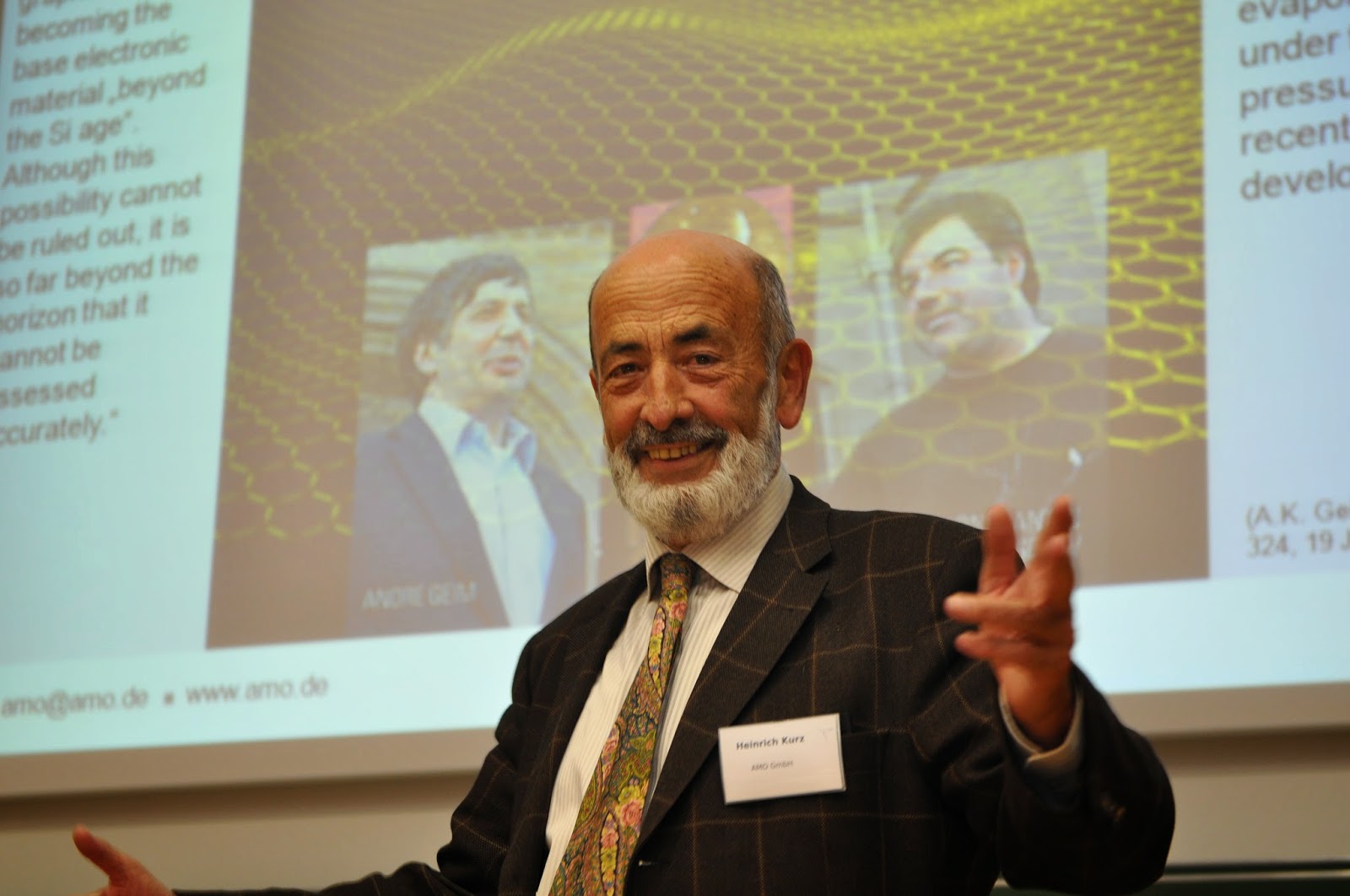
Prof. Heinrich Kurz (Foto von Prof. Gianaurelio Cuniberti)
Prof. Heinrich Kurz vom Institute of Semiconductor Electronics an der RWTH Aachen, GF der AMO GmbH, sowie designierter Leiter des Grapheme-CA [Graphene Flagship] versprach mit seiner Vorlesung "Graphen - Das neue Silizium des einundzwanzigsten Jahrhunderts?" einen aufschlussreichen Abend.

Einführend in das Thema des Abend war die erste Folie mit einer Darstellung von Moores Law (alle ca. 18 Monate verdoppelt sich die Anzahl der Schaltkreise auf einer gleichbleibend großen Chipfläche aus Silizium). Was damals zunächst wie ein Werbegag von Intel klang, um deren Konkurrenz zu verschrecken "bewahrheitet" sich als konstantes Paradigma. Erst ein Jahr zuvor hatte Ray Kurzweil, Futurist, Erfinder und Mitgründer der Singularity University auf dem 4. Dresdner Zukunftsforum davon in seinem Vortrag ebenfalls gesprochen.

Doch halt! Können wir den Implikationen für Wirtschaft, Gesellschaft und unser eigenes Leben, die sich aus diesem Paradigma ergeben überhaupt folgen? Zunächst werden derartige Entwicklungen stets unterschätzt (sowohl von der Öffentlichkeit als auch von den Medien - wer hat in den letzten drei Jahren in den lokalen Medien viel über "Moores Law" und "Graphen" gelesen oder gehört?). Kurz gesagt: unterschätzen wir (noch immer) die Zukunft?

Was mit der Erfindung des integrierten Schaltkreis und den Aktivitäten in Silicon Valley rund um die damals noch reichlich unbekannte Hochschule Stanford University (übrigens hervorgegangen aus einer privaten Stiftung) sich abspielte (sehr anschaulich in dem von Everett M. Rogers und Judith K. Larsen verfassten Buch "Silicon Valley Fieber" beschrieben) und den ersten "exponentiellen Steinwurf" in die Stille des "linearen Denkens" darstellte sollte noch übertroffen werden. Bereits 2002 wurde in einem Artikel in IEEE Spectrum [englisch] auf das Verschwinden des Transistors bei ständiger Miniaturisierung hingewiesen. Wo es genau hingehen (könnte) war noch nicht absehbar.

2004 war Graphen ("Wundermaterial" in Atomschichtdicke) von zwei russisch-stämmigen Wissenschaftlern entdeckt worden, die für ihre Entdeckung bereits 2010 den Nobelpreis für Physik erhielten. Seitdem hat das Interesse (innerhalb der Wissenschaft, weniger der allgemeinen Öffentlichkeit) an diesem "Wundermaterial" exponentiell zugenommen.

Ohne eingehender auf den Vortrag vom 28. Oktober 2011 einzugehen springen wir ins Jahr 2014. Wir schreiben den 20. Oktober 2014. Der Chiphersteller GLOBALFOUNDRIES, der auch in Dresden mit seinem Werk GLOBALFOUNDRIES Fab1 präsent ist gibt an diesem Tag bekannt, dass er die (verlustreiche) Halbleitersparte von IBM komplett übernimmt (Computer-Oiger sowie HTxA - HighTech x Agency und Silicon Saxony e.V. berichteten ebenfalls). Ebenfalls an diesem Tag veröffentlichte Peter Diamandis seine Gedanken zur Zukunftsentwicklung und Anwendungsfeldern von Graphen, die den wenigsten von uns bekannt sein dürfte im Wirtschaftsmagazin Forbes [English].

Doch was hat dies mit Graphen und dem Vortrag von Prof. Heinrich Kurz zu tun? IBM bereitet sich bereits auf die Nach-Silizium Zeit [englisch] vor und kann nun verstärkt Forschung in Richtung neuer Materialien, insbesondere Graphen, im Halbleiterbereich betreiben. GLOBALFOUNDRIES hingegen gewinnt durch den Deal die Möglichkeit entsprechendes eigenes Know-How in der Skalierung für neue Technologien (z.B. mögliche Integration von Graphen in bestehende Produktionsprozesse) einzubringen. Eine Win-Win-Situation aus volkswirtschaftlicher Sicht, können sich doch die Player auf ihre Stärken konzentrieren. Dresden gewinnt damit die Chance, die Forschung für zukunftsweisende Technologien auszubauen und angrenzende Anwendungsbereiche und Startup-Ecosystems entstehen zu lassen. Waren doch bereits 2011 acht (!) Institute an der Nöthnitzer Straße am südlichen Campusrand der TU Dresden mit der Forschung rund um die Nutzung von Graphen im Halbleiterbereich beschäftigt. Die Entscheidung von gestern sollte demnach weiteren Auftrieb für Forschung und Applikationsentwicklungen rund um Graphen bringen - auch und besonders hier in Dresden - nach sich ziehen.

Prof. Kurz schloss seinen damaligen Vortrag mit folgendem Vorschlag: "Ich schlage Ihnen vor, die Straße [Nöthnitzer Straße; Anm. der Verfassers] in Graphen-Straße umzubenennen!"

"Warum nicht?"


Saturday, March 30, 2013

Learning is Life - Peter Senge on Action Learning

Life is an amazing learning space, actually the only one. School should be an accelerator rather than a compliance creating space with boundaries. There some early steps around the world in this direction already.

Which ones have you come across? 

My most impressive example (which I have seen in practice) is Team Academy, Jyväskyla, Finland, and the other emerging is Singularity University founded by Peter Diamandis & Ray Kurzweil which led to BlueFuture2012 and my personal deep involvement in bringing "Abundance - The Future is Better Than You Think" into awareness in order to collectively learn on how to shape the future together using the emerging information technology that is reaching the corporate, as well as the educational space.


Happy Easter, and enjoy Peter's talk

Ralf

Tuesday, February 12, 2013

A Wonderful Day in Athens

Hello Systemdynamicists!

It's been a while since the previous newsletter, not too much action in the group ("Why is that so?", I would like to ask).

End of July a terrific International System Dynamics Conference (ISDC) took place in the beautiful Greek capital, Athens. It was hot outside, nicely temperatured inside (good job of the aircondition!) and the meetings, personal talks, new connections, enjoying Frappés at 2AM in the morning was just inspiring. I can tell everyone who hasn't yet been to an ISDC: Go and let go your thoughts on what you could get out of it. Let the process decide and you will be thrilled:-)

Systemic issues, whether it climate change, banking crisis, vaccination problems in developping countries, are more than ever relevant to our actions in our organizations in whatever position we are acting.

The practical use of system dynamics is therefore sneaking into public vision. The following are a few links and announcements on projects that currently ongoing. Joining in is highly appreciated:
  1. Hazhir Rahmandad, Professor in System Dynamics at Virginia Tech, is looking for collaborative organizations to get students work on complex real-world issues. Through new Web 2.0 collaboration technology even new ways of collaboration across country boundaries seem to be possible. - If you are not sure whether to apply don't hesitate to get in touch with me, as well (especially if based in Germany and Europe).
  2. During the ISDC the SIG Business Roundtable we met and decided to take forward the effort of past years in grounding the connecting of real-world business issues to future ISDCs. Please check-out SIG Business at WikiSD and (if you are a Member of the International System Dynamics Society already) put your ideas, wishes, knowledge there. Only collectively working together sharing knowledge will lead to the change we all would like to see (slightly changed from a quote of Ghandi).
  3. As system dynamics is for most people not the searched for solution and tool to their problems have a look at RealworldSD. Interested in contributing to the blog as a writer? Please indicate so, you are heartily welcomed.
For all of you who are not familiar with the WikiSD (a Wikipedia like open wiki where you can freely (as member of the International System Dynamics Society) can add, edit, expand and write on system dynamics issues that are of relevance to the community of systemdynamicists (the big shots, professors, current students (as I am one right now at WPI, where I do a Master in System Dynamics).

Especially have a look at the Resources at WikiSD [currently not on official System Dynamics Society Websit] to become familiar with the field and what is already published there.

What do you think of setting up a meeting early next year somewhere in Europe (with easy access with rail and air transport) to meet in person and arrange a European SD Meeting, especially around questions on how SD can be more easily made applicaple to thought leaders, the public, in your organizations where you are part of the work force, universities that are not strong in SD, etc.? Love to hear your opinion on that and will open up a new forum in the group.

That should be all for now and I wish you all a lovely weekend with later summer sun and similar temperatures.

Cheers,

Ralf

[written in summer 2008]

Sunday, January 20, 2013

Exzellenz und Nutzung künftiger Möglichkeitsräume


Heute am dritten und letzten Tag der Karrierestart, einer der größten Messen zu Karrierethemen in Deutschland, hieß es ab 11 Uhr: "Unternehmerfrühstück". Nachdem im vergangenen Jahr Vorträge von Referenten aus München und Hamburg zu erleben waren, stand diesmal Lokales auf dem Programm.

Der Bürgermeister für Wirtschaft der Landeshauptstadt Dresden, Dirk Hilbert, führte in den Morgen ein bevor der Rektor der TU Dresden, Prof. Hans Müller-Steinhagen über die "Exzellenzuniversität TU Dresden, Ursache und Auswirkung" berichtete.

Einige Zitate von Herrn Prof. Müller-Steinhagen, die viele der anwesenden rund 200 Gäste aufhorchen ließen (nicht vollkommen O-Ton): "Alles was wir haben ist hier zwischen unseren Ohren", "Vorsprung vor unseren Wettbewerbern - wenn wir den nicht halten verlieren wir unseren Lebensstandard", "Wenn Sie einmal nach Asien schauen. Bildung ist dort ein Top-Thema, das mit wesentlich höherem Einsatz vorangetrieben wird, als das bei uns der Fall ist."

Was also ist zu tun? Sachsen seit Jahrhunderten stets bekannt für unkonventionelle Lösungen sollten auch auf diesem Gebiet einige umsetzbare Ideen bereits in der Umsetzung haben.

Es folgte ein kurzer Abriss über die Geschichte der TU Dresden:

Vergangenheit: 185 Jahre alt • 80% der TU im Febr. 1945 zerstört • seit 1990 Volluniversität • 50% Mitarbeiter entlassen in 1990 (!)

Gegenwart: Fünftgrößte Universität Deutschlands • "TU Dresden wächst und wächst" • 126 Studiengänge • Patentanmeldungen: 116 (2011)

Zukunft:  Kultur und Wissen - wenn nicht in Dresden, wo dann? • Rang 100 (288 (2012), 340 in 2011) Ranking Top Universities • "Das Wissen darf nicht für die Schublade erarbeitet werden, sondern muss wirtschaftlich nutzbar gemacht werden!" • 15 Ausgründungen, an denen TU Dresden Anteile hält (und es sollten mehr werden)

In einem Satz zusammengefasst. "Die ganz großen Herausforderungen der Menschheit können wir nur im Zusammenspiel der unterschiedlichen Disziplinen lösen" und dazu kann (auch) die TU Dresden, wie auch andere Bildungsinstitutionen in der Landeshauptstadt Dresden eine gewichtige Rolle im internationalen Wirtschafts-konzert spielen.

Life Science • Information Technology • Intelligent Materials • Kultur & Knowledge • Energy & Sustainability - the five pillars of the TU Dresden, clearly setting a tone for the future of #Abundance

Dass Dresden und die TU Dresden auch in der Welt ankommen sind zeigt der Artikel in der NY Times vom  2013-01-14 - ein Beginn auf den sich mit vielen kleinen, mittleren und großen Steinen der Zusammenarbeit ein globales Netzwerk der gemeinsamen Kooperation zur Lösung der ganz großen Herausforderungen der Menschheit aufbauen lässt.

Der "Dresden Spirit", man spürte ihn heute morgen und auf einem anschließenden Rundgang auf der Messe. Nun heißt es "lediglich" die vielen Einzelsteine und Aktivitäten für das große Ziel zusammenzufügen:

The World being Drawn to Saxony - as August the Strong made it already happen   


Friday, October 19, 2012

2012 is THE YEAR - Watch the videos yourself if you choose so

Dear Reader of this blog!

This blog started after the first Lean Thinkers Conference at the University of Applied Sciences HTW Dresden back in October 2007. The name of it stems from this time. Over time many different disciplines, perspectives, and approaches have accumulated, such as adding an intense part on Saxon State Opera Semperoper and the Semperoper Ballett Company, as well as fields like system dynamics.

After five years now, in the age of five, it seems that the "baby" has grown up to not just learn more, but to put learning into practice. In doing so, using modern information technology as the key enabler, that often comes a wall into sight, like "The Wall" that separated the "West" from the "East" and caused the "Cold War": people, and organizations stay in front of their own "mental wall" denying possible, not yet done changes in education, business, and civic engagement.

However 2012 being the 100th birthday of Alan Turing on 23rd of June (just two days before my own birthday) it enables the power of positive change towards abundance, leveling the inequalities of the world by the use of information technology across boundaries.

Peter Diamandis' latest talks about "Abundance - THE FUTURE IS BETTER THAN YOU THINK" have sparked various thoughts, and actions.


Get yourself sparked, and inspired to take action in our world of ABUNDANCE watching Peter in these two videos yourself:


If you'd like to add any thoughts, action points, or comments feel free to do so here.

Cheers, Ralf

PS.: Despite the fact "sailing through rough life waters" it is always great to be pulled forward towards one's own dreams. If you not sure what is driving me really that passionately, please ASK.

Wednesday, August 22, 2012

The Best Way to Create a Future of Abundance is to Create it Yourself

Heute wurde in der sächsischen Landeshauptstadt Dresden (man bezeichnet bekanntlich diese Region als Silicon Saxony, ob ihrer ungebrochenen Innovationskraft) ein Innovationsprogramm der Bundesregierung vorgestellt. Genauer gesagt vom Bundesministerium für Bildung und Forschung wie auf den Seiten von Unternehmen Region zu erfahren ist.

Der "Oiger", AKA Heiko Weckbrodt, berichtete bereits auf seinem Blog darüber. Details waren im Vorfeld bis heute morgen nicht zu erfahren auch nicht über die Pressekonferenz, noch wo sie genau stattfand.

Foto: Angela Incampo
Erreicht es wirklich die Creative Class, die kreativen Köpfe, die in Sachsen teilweise das Unmögliche möglich machen, wenn diese nicht bereits bestehenden Forschungsclustern, Universitäten oder universitätsnahen Institutionen angehören?

Wie können 500 Millionen Euro die Neuen Bundesländern zu nachhaltig prächtig blühenden Landschaften gestalten, und dabei anderen europäischen Volkswirtschaften wie Griechenland helfen?

Ein tieferer Blick in das Programm Zwanzig20 bringt ein wenig mehr Aufschluss über den Weg der Zielerreichung (Welches ist das Ziel? Wie erfolgt die Messung des Erfolges?) und Mindestanforderungen:

  • eine unabhängige Jury (Wer?) bewertet die eingereichten Konzepte
  • Kompetenz, Finanzkraft, Organisations-, Management-, Kooperations- und Leistungsfähigkeit, um das adressierte Problem gemeinsam lösen zu können (Wie können sich über Social Networks und Web Tools agierende Partner für Förderung qualifizieren?)
  • mindestens ein Partner in Westdeutschland (Kann auch einer/ mehrere Partner im Ausland sein?)
  • eine ausgearbeitete, technische, organisatorische und ökonomische Roadmap (Wie wird eine Initiative berücksichtig, die sich in schnellen iterativen Schritten dem Ziel anhand des Lean Startup und Lean Thinking ähnlich wie Toyota nähert?)
Abschließend der visionäre und doch nicht abwegige Wunsch, dieses Programm mit der X PRIZE Foundation von Peter H. Diamandis zu verknüpfen, um den Mitteldeutschland Jobs X PRIZE ins Leben zu rufen und lean zu starten, sowie exponentiell zu beschleunigen wie es Ray Kurzweil auf dem 4. Dresdner Zukunftsforum eindrucksvoll beschrieb.


Monday, May 28, 2012

OECD WORKSHOP ON NATECH RISK MANAGEMENT

(Natural Hazards Triggering Technological Accidents)

I believe it is good, before I start my article, to explain the meaning of the words OECD and NATECH.
OECD : Organisation for Economic Co-operation and Development.
(A useful definition for) NATECH: A “Natech” accident is a “chemical accident” caused by a natural hazard or a natural disaster. “Chemical accidents” include accidental oil and chemical spills, gas releases, and fire or explosions involving hazardous substances from fixed establishments (e.g. petrochemical, pharmaceutical, pesticide, storage depot), and oil and gas pipelines.

http://www.flickr.com/photos/usnavy/5523450134/
Now let’s get started.
Not many people and not many facilities are aware of the impact natural hazards could have on environment and on people’s life. This theme as well as the strong connection between natural events and potentially dangerous technology-related-facilities, was the subject of a workshop held 23rd - 25th May 2012 in the Congress Zentrum in Dresden (Germany).
The city of Dresden, severely damaged by the flooding in August 2002, wants to be as much as possible prepared in case a new flooding should occur, a possibility that seems to be not so remote as one could imagine.
The continuous and quick climate changes the world is facing in the last few years, leave no doubts that new and more frequent  weather-related events could occur.
Let’s think at the hurricanes and tornados that created above the ocean near Africa move towards the American’s states, or at the frequent earthquakes that are hitting  the north of Italy since the beginning of this year, or at the earthquake that hit Japan and Fukushima last year, causing a nuclear power disaster. Nevertheless, countries like the Philippines are continuously subjected to natural hazards: earthquakes, tsunamis, volcano eruptions, floods are part of the daily life.
What would happen if these natural hazards, whose strength goes well beyond the human control, would hit and destroy facilities engaged in working and storing chemical or toxic substances?
What would happen to the population living there, to the fields, the rivers, the flora and the fauna of these places and to the whole eco-system?
Are the facilities involved in producing and/or storing dangerous substances aware of these risks? And most important of all, are they ready to cope with natural events (or even with bush fire), whose destroying power could go beyond our prediction?
Disappointingly, the present situation is not as good as we could expect. Many facilities involved in producing or transforming dangerous substances, would not be able to cope with natural hazards whose strength is stronger than usual. In other words, they are not ready to face a potential (not-yet-experienced)-natural disaster.  
Most of these facilities have been built many years ago in respect of the various needs and requirements of the time. In the course of the years, however, things have changed and they are going to change further. These facilities, therefore, need to be put in “safety”, need to re-think at the dangerousness of the substances on the view of present and forecasted future natural hazards.
Natural hazards do not make any difference among OECD member countries and not OECD member countries, therefore, these problems are of same relevance for all countries.
At the end of a very interesting and well organized workshop some conclusions and recommendations on Natech Risk Management were drawn:
  • Methods and tools for industrial Natech risk analysis and territory mapping with help of GIS (Geographic Information System) for identification and monitoring of Natech risk locations are extremely important
  • Elaboration of guidance, strength co-operation and experience exchange among  OECD member countries and not OECD member countries have to be promoted
  • Environmental insurance against Natech Risk for facilities and installation already existing and/or in construction is of great relevance
  • Natech risk analysis should be taken into consideration when locations for new facilities are chosen
New scenarios open in front of our eyes, a lot of work needs to be done and an even stronger co-operation among experts, governments and facilities needs to be promoted and supported. The earth belongs to all its inhabitants and it is in the interest of all to protect it and to keep it as safe as possible.

Interesting could be to give a look also to:
IEEE TTM: Technology Time Machine
Abundance: Future is better than you think

Thursday, May 3, 2012

Digital Icon Talking with his Daughter

Lass' Dich nicht überfluten.


Lerne, mit den neuen Medien umzugehen.
Das geschieht, sobald Du dich traust und Du es alleine
probierst.

Aus Mainz, der Heimatstadt des Erfinders des 
Buchdrucks mit beweglichen Lettern, 
Johannes Gensfleisch zu Gutenberg, 
stammend ist mir das, was Howard 
beschreibt seit frühester Kindheit 
bekannt.

Früher waren es Bücher, heute sind
es andere Medien, wie Google, Twitter,
Facebook, LinkedIn, XING, ...

Lass' Dich nicht unterkriegen, nutze die Chancen, die vor Dir liegen! >> Abundance

Friday, April 20, 2012

BMW meets the Change Accelerators

Meeting the Change Accelerators, and it's not just this one ;-) More on the WIRED UK & BMW i featured stories.

Salim Ismail (2nd, lower row), Global Ambassador of Singularity University, a multi-disciplinary think tank bringing together the brightest minds for a 10-week summer bootcamp from around the world at #GSP12

Rachel Armstrong (3rd upper row), Living Material Innovator, TED Fellow, living and researching in Venice, where in June 18 - 22 June the IoT (Internet of Things) Week 2012 takes place

.. to just name the two who have inspired me quite a bit, and last but not least BMW Plant Leipzig. The five years there, 2003-2008, building up processes from scratch, and most certainly often by using disruptive, and innovative approaches still stick, and shape my thinking, and acting towards #abundance.

On board for building a connection with Silicon Valley, and scale your business up? What's bothering you?

http://www.abundancethebook.com/about-the-book-cover/