Showing posts with label PeterDiamandis. Show all posts

Tuesday, October 21, 2014

Graphen - Die "unsichtbare" Macht des Wandels

Fast auf den Tag vor drei Jahren fand am MPI-PKS (Max-Planck-Institut für Physik Komplexer Systeme) ein Workshop mit dem kryptisch lautenden Namen "Carbon-based Spintronics" statt. "Wer hatte schon zuvor (außerhalb der Wissenschaftsgemeinschaft und industrienahen Forschung) davon gehört?" - die wenigsten Bürger Dresdens wahrscheinlich (mich eingeschlossen).

Der öffentliche Abendvortrag am 28. Oktober 2011 (übrigens wie viele Vorträge und Vorlesungen öffentlich im Science Kalender Dresden zu finden) sollte mit einigen Überraschungen aufwarten.
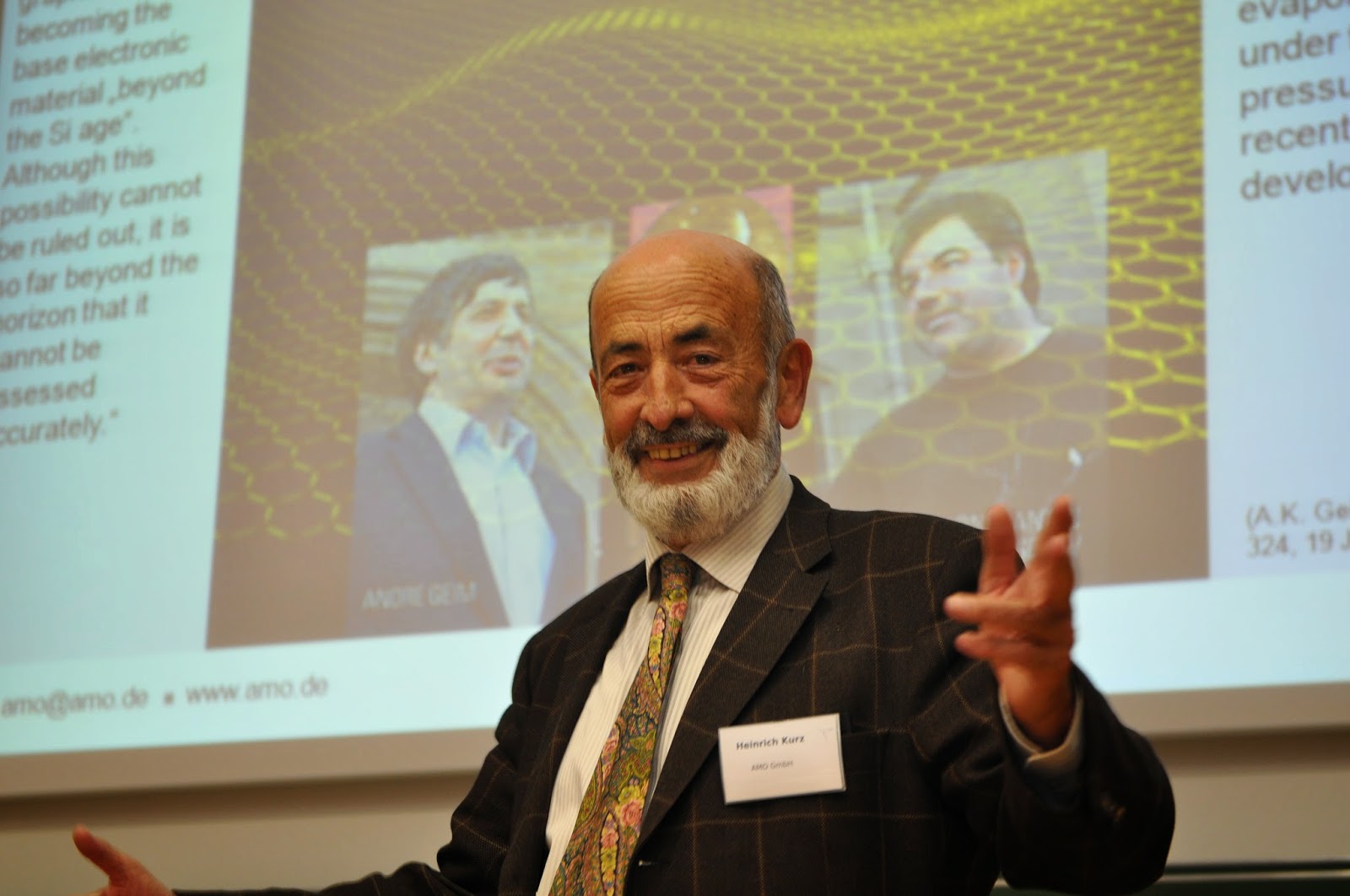
Prof. Heinrich Kurz (Foto von Prof. Gianaurelio Cuniberti)
Prof. Heinrich Kurz vom Institute of Semiconductor Electronics an der RWTH Aachen, GF der AMO GmbH, sowie designierter Leiter des Grapheme-CA [Graphene Flagship] versprach mit seiner Vorlesung "Graphen - Das neue Silizium des einundzwanzigsten Jahrhunderts?" einen aufschlussreichen Abend.

Einführend in das Thema des Abend war die erste Folie mit einer Darstellung von Moores Law (alle ca. 18 Monate verdoppelt sich die Anzahl der Schaltkreise auf einer gleichbleibend großen Chipfläche aus Silizium). Was damals zunächst wie ein Werbegag von Intel klang, um deren Konkurrenz zu verschrecken "bewahrheitet" sich als konstantes Paradigma. Erst ein Jahr zuvor hatte Ray Kurzweil, Futurist, Erfinder und Mitgründer der Singularity University auf dem 4. Dresdner Zukunftsforum davon in seinem Vortrag ebenfalls gesprochen.

Doch halt! Können wir den Implikationen für Wirtschaft, Gesellschaft und unser eigenes Leben, die sich aus diesem Paradigma ergeben überhaupt folgen? Zunächst werden derartige Entwicklungen stets unterschätzt (sowohl von der Öffentlichkeit als auch von den Medien - wer hat in den letzten drei Jahren in den lokalen Medien viel über "Moores Law" und "Graphen" gelesen oder gehört?). Kurz gesagt: unterschätzen wir (noch immer) die Zukunft?

Was mit der Erfindung des integrierten Schaltkreis und den Aktivitäten in Silicon Valley rund um die damals noch reichlich unbekannte Hochschule Stanford University (übrigens hervorgegangen aus einer privaten Stiftung) sich abspielte (sehr anschaulich in dem von Everett M. Rogers und Judith K. Larsen verfassten Buch "Silicon Valley Fieber" beschrieben) und den ersten "exponentiellen Steinwurf" in die Stille des "linearen Denkens" darstellte sollte noch übertroffen werden. Bereits 2002 wurde in einem Artikel in IEEE Spectrum [englisch] auf das Verschwinden des Transistors bei ständiger Miniaturisierung hingewiesen. Wo es genau hingehen (könnte) war noch nicht absehbar.

2004 war Graphen ("Wundermaterial" in Atomschichtdicke) von zwei russisch-stämmigen Wissenschaftlern entdeckt worden, die für ihre Entdeckung bereits 2010 den Nobelpreis für Physik erhielten. Seitdem hat das Interesse (innerhalb der Wissenschaft, weniger der allgemeinen Öffentlichkeit) an diesem "Wundermaterial" exponentiell zugenommen.

Ohne eingehender auf den Vortrag vom 28. Oktober 2011 einzugehen springen wir ins Jahr 2014. Wir schreiben den 20. Oktober 2014. Der Chiphersteller GLOBALFOUNDRIES, der auch in Dresden mit seinem Werk GLOBALFOUNDRIES Fab1 präsent ist gibt an diesem Tag bekannt, dass er die (verlustreiche) Halbleitersparte von IBM komplett übernimmt (Computer-Oiger sowie HTxA - HighTech x Agency und Silicon Saxony e.V. berichteten ebenfalls). Ebenfalls an diesem Tag veröffentlichte Peter Diamandis seine Gedanken zur Zukunftsentwicklung und Anwendungsfeldern von Graphen, die den wenigsten von uns bekannt sein dürfte im Wirtschaftsmagazin Forbes [English].

Doch was hat dies mit Graphen und dem Vortrag von Prof. Heinrich Kurz zu tun? IBM bereitet sich bereits auf die Nach-Silizium Zeit [englisch] vor und kann nun verstärkt Forschung in Richtung neuer Materialien, insbesondere Graphen, im Halbleiterbereich betreiben. GLOBALFOUNDRIES hingegen gewinnt durch den Deal die Möglichkeit entsprechendes eigenes Know-How in der Skalierung für neue Technologien (z.B. mögliche Integration von Graphen in bestehende Produktionsprozesse) einzubringen. Eine Win-Win-Situation aus volkswirtschaftlicher Sicht, können sich doch die Player auf ihre Stärken konzentrieren. Dresden gewinnt damit die Chance, die Forschung für zukunftsweisende Technologien auszubauen und angrenzende Anwendungsbereiche und Startup-Ecosystems entstehen zu lassen. Waren doch bereits 2011 acht (!) Institute an der Nöthnitzer Straße am südlichen Campusrand der TU Dresden mit der Forschung rund um die Nutzung von Graphen im Halbleiterbereich beschäftigt. Die Entscheidung von gestern sollte demnach weiteren Auftrieb für Forschung und Applikationsentwicklungen rund um Graphen bringen - auch und besonders hier in Dresden - nach sich ziehen.

Prof. Kurz schloss seinen damaligen Vortrag mit folgendem Vorschlag: "Ich schlage Ihnen vor, die Straße [Nöthnitzer Straße; Anm. der Verfassers] in Graphen-Straße umzubenennen!"

"Warum nicht?"


Saturday, March 29, 2014

All is Possible - Sometimes we Have to Look Back to Really See


First of all, it may sound odd, but most often you step across the most amazing things, paths or learning while searching intensively for something else. That is called SERENDIPITY (I personally didn't know about it until coming back from a conference on organizational learning in Muscat, Oman, in April 2008).

Around the time of the making of the video below (actually, it is more something like a full version movie, which carries lots of learning along the two hours) I was studying economics at the University of Bamberg. The "Iron Curtain" had fallen just some years earlier and as Bamberg is only 50 km away from the closed former East German border quite a few visits pulled me "over the border".

What I could see in the villages, and towns as well as talk to locals there was a social and economic system almost on the edge of collapse (quite what is the topic of the conversation in the movie with the makers of "Limits to Growth" (published in 1972, the link is to the original book version) Donella Meadows, Dennis Meadows and Jørgen Randers).


"Beyond the Limits" Global Tomorrow Coalition (1992)

20 years later living now in Eastern Germany, to be more exact in Dresden, now one of Europe's major hotspots for semiconductors (two major chip factories are found within city limits) and other emerging technologies such as plastic electronics, nanotechnology, life sciences, the mind flashed back to the days back in 1992 sitting in lectures, and hearing on how the economy of former East Germany could be sustainably transformed. Lots of effort was put into place, money flowed, and companies pushed out their products which the people eagerly bought as they lacked to have them over decades. All seemed possible.

Where do we stand now over 20 years later?

A question everybody of us has to ask her-/himself.

For me personally, the flow of action was as follows: while still in Bamberg I caught a copy of "The Machine that Changed the World" by Womack/Jones and somehow combined with what I had learned in my economics studies was hooked on what is called "Lean Thinking". The essence in short is to create more value with the given resources in a sustainable way, and at the same time enable all members of the workforce (from C-level to shopfloor) to cross-collaboratively learn to achieve the goal (more value with given resources) together.

Over the years I found myself in Dresden, where I moved right in the midst of the Economic Crisis of 2008/2009 with a dream my Finnish friends (whom I had met earlier in 2008 in Muscat, Oman) sort of whispered over via their blog. Google just had started a global competition, and people were asked to hand in their visions of the vision. I handed in what in version 1.0  was called Team Lea(r)ning Experience (something similar to what I had seen in Finland at Team Academy, a "management school without teachers" (as Peter Senge used to call it). Just a few months later in the spring of 2009, this vision became a name that sticks since then:


Vision: bringing together citizens, students, businessmen, and researchers to give their special skills/ knowledge/ networks to enable something similar to what Singularity University has established in 2008 and to make a difference. This could be to create a startup with the help of others, bring new knowledge back to their companies, share the challenges that they face in their organizations and get new innovative solutions from the teams at LockSchuppen

Mission: create a place where the emerging future can be seen, touched, and used (through prototypes of new technologies and applications) - moving the learning from reading to "tactile learning" across all genders, ages and disciplines

How can it be achieved?

It probably needs more than just a group of dedicated people eager to work on the vision, some tools, and structure. A framework on how to achieve such bold goals is what is useful to set the course. An example of such an approach called u.school gives Otto Scharmer who started in a similar direction in 2008 first on his blog, and then with Presencing Institute.

Currently running is a MOOC called "Leadership MOOC" (website not active any longer) which is co-organized by the Presencing Institute and GIZ (Deutsche Gesellschaft für Internationale Zusammenarbeit GmbH), is free of charge and has the title:


Feel free to attend (it started just this week, and we are already three attendees from Dresden - maybe you are the next). In case you are more orientated to learn for yourself new ways to tackle really complex challenges have a look at "The Systems Thinking Playbook on Climate Change" which can be downloaded free of charge from the website of the GIZ.

Have a relaxing Sunday, and enjoy with your friends, look out for a bright future, and appreciate the diversity around you. We will meet Egypt tomorrow here in Dresden, quite by another serendipity encounter, a call from Cairo yesterday. 

Everything is connected, and everybody makes it valuable together.


Friday, December 27, 2013

The 1000 Small Steps - Accelerating by Sharing

The Web is really the hot bed of serendipity - just watching the latest Tatort with hilarious screenplay, seeing a message by Gunter Pauli, founder ZERI, then read on Facebook about a new mobile technology that will be presented by Samsung at upcoming CES 2014 in Las Vegas I stumbled across the following:

The 1000 Small Steps

Wonderful to read, and once again I got encouraged that what my role models in life, and education Jay W. Forrester, Ronald Coase, Edgar H. Schein, John D. Sterman, Peter Claussen and Peter Diamandis have taught me over the past 20 years is there to become reality in the near future.

http://BlueFuture2012.blogspot.com ... also got its seeds in 2012.

ABUNDANCE IS THERE TO COME ... AND IT IS ALREADY ON THE ROAD

Happy New Year 2014 with amazing things to happen to all !!!!

Tuesday, May 14, 2013

Saxony - A True Global (Emerging) Attractor


Saxony establishes itself as an immigration country - best saldo since 1995

Saxon State Minister for Economic Affairs, Labour and Traffic, Sven Morlok, presented on 2013-04-25 during a press talk at GLOBALFOUNDRIES Fab 1 the most recent developments of the immigration status (from inner Germany, and abroad) towards Saxony. The meeting also took the chance to gratulate Mr. and Mrs. Trepte a couple with Saxon origins that relocated to Saxony, after working three years in Schleswig-Holstein and in 2012 both relocating to Saxony, and working at GLOBALFOUNDRIES Fab 1 now.

The positive overall message that emerged from this morning on the edge of Dresden is that Saxony attracted more people in 2012 (triple the number of 2011) to move into Saxony than Saxons moving out of the state. This is especially valuable in times of the developments of overall workforce (in the tradional sense employment) due to aging demographics.

As the presented data (presentation, in German) showed the strongest inflow of people into Saxony had been from outside German. This indicates the rising awareness of the attractiveness of the region in the world on the one hand, especially in the hightech arena. On the other hand other economic dynamics in the Southern parts of the European Community, and Eastern Europe fall into place.

The cities Dresden, Leipzig, and Chemnitz which have drawn in the most incoming people, and their saldo is mostly positive, are thriving economically. Quite different is the situation on the edges of the Free State of Saxony such as the Ore Mountains, or the Lausitz region that still face a braindrain even though their industries are at high levels of quality.

Several questions by other press members in the round at the end of the presentation made clear that a deeper distinction of the returning people (presently a large number of incoming people is due to students starting their studies at of Saxony's universities), and the intentions of them may lead to further insights on acting towards future labour incentives in Saxony.

Concerning the question on the overall impact of the significantly lower transfer payments by European Community, and the finish of the Solidarpakt II in 2019 State Minister Sven Morlok drew attention to the newest report by ifo Dresden from 2012. He also mentioned that the impact on BIP (Brutto Inland Product) due to this development will be between -0.5% and -1% for Saxony (as stated by a recent research study by ifo-Institute Dresden, ifo Dresden berichtet, from page 21 on, in German)

This drew out another question on whether a specified model of an X PRIZE for job creation as proposed by  Peter Diamandis in the Huffington Post could be put to action in Saxony to not only create jobs, but also draw interest towards Saxony on global scale. At the same time enabling local companies, and uprising startups to generate future economic, wealth, social, eduction, and business innovations that once were famous for Saxony.

Saxony clearly has advantages in comparison to other regions in Germany, even though being on the edge, and only more recently capturing rising global interest. GLOBALFOUNDRIES and other internationally active, and connected players give a more than positive sign on which to build on in the coming future.

May the region further strive, and take the chance of diminishing public funding streaming into Saxony as the driver for lasting economic wealth creation across all disciplines, and levels of business.

Ralf Lippold

Friday, October 19, 2012

2012 is THE YEAR - Watch the videos yourself if you choose so

Dear Reader of this blog!

This blog started after the first Lean Thinkers Conference at the University of Applied Sciences HTW Dresden back in October 2007. The name of it stems from this time. Over time many different disciplines, perspectives, and approaches have accumulated, such as adding an intense part on Saxon State Opera Semperoper and the Semperoper Ballett Company, as well as fields like system dynamics.

After five years now, in the age of five, it seems that the "baby" has grown up to not just learn more, but to put learning into practice. In doing so, using modern information technology as the key enabler, that often comes a wall into sight, like "The Wall" that separated the "West" from the "East" and caused the "Cold War": people, and organizations stay in front of their own "mental wall" denying possible, not yet done changes in education, business, and civic engagement.

However 2012 being the 100th birthday of Alan Turing on 23rd of June (just two days before my own birthday) it enables the power of positive change towards abundance, leveling the inequalities of the world by the use of information technology across boundaries.

Peter Diamandis' latest talks about "Abundance - THE FUTURE IS BETTER THAN YOU THINK" have sparked various thoughts, and actions.


Get yourself sparked, and inspired to take action in our world of ABUNDANCE watching Peter in these two videos yourself:


If you'd like to add any thoughts, action points, or comments feel free to do so here.

Cheers, Ralf

PS.: Despite the fact "sailing through rough life waters" it is always great to be pulled forward towards one's own dreams. If you not sure what is driving me really that passionately, please ASK.

Friday, October 8, 2010

A Dream is Growing


What dream will become reality in this brick and mortar environment with a history of almost 110 years - two wars, two economic systems, 5 years of emptiness, and an unspoken future?

What is the building the shadow of the pole is pointing calling (perhaps even screaming) at you to do?

Sunday, June 6, 2010

Obstacles that Make You Grow


From a very dear friend, even though we have only met once or twice in Berlin in Person, Frauke has been the inspiration to start bringing my vision of creating a better place for co-learning ad collaboration into place. Thanks a lot Frauke and also to Wiebke for making the change happen :-) Self-HUB is coming back!
The following are true whenever you face a dead-end road of your dreams. You are sure that nothing will work, and any energy will be a waste in its own. NOT QUITE SO :-)
IF YOU FEEL LIKE IT DO PUT YOUR FINGERS ON THE KEYBOARD AND SHARE YOUR EXPERIENCE OF THE PAST.
And some inspiration from the past international BPW President:
Inspiration for New Year 2009
If you never face obstacles,
Could you be a success?
Could you set strategies
To achieve your greatness?
If you never get criticize,
Could you fix flaws in time
Before they cause problems
Before they do you harm?
It takes the darkness of a cocoon
To turn a caterpillar into a butterfly.
It takes an extreme pressure and heat
To turn coals into a diamond mine.
To attain the highest honor in life
Face challenges without fear
Let wisdom be your guide
To victory and cheers.
Warm Wishes,
Chonchanok Viravan (Nok)
(Written by Chonchanok Viravan, 12 Dec 2008)

Saturday, May 1, 2010

The Best Way to Predict the Future is to Create it Yourself

Copyright: SingularityUniversity
For roughly two years I am working on setting up a team entrepreneurial startup think tank here in Dresden. It's name is LockSchuppen and the goals are ambitious. People tell me sometimes that this would be crazy. Interestingly these are not the entrepreneurial orientated ones, at least they are bound to a company and get their monthy cheque. Perhaps they are just scared and see that they could do similar with their visions they have in mind and don't dare to bring them into action.

Why is that so?

What is it that makes people often see more the risks than the chances in taking something new into the world?

If you are in a similar state, I highly recommend PeterDiamandis' video lecture at Singularity University:

Saturday, April 17, 2010

When in Doubt ....

1. THINK! (by PeterDiamandis)

2. DEFINE YOUR IDEA

What makes your idea connected to the mainstream? Or is is way ahead and seemingly impossible?

What has been your experience in bringing it forward?