Showing posts with label GLOBALFOUNDRIES. Show all posts

Tuesday, October 10, 2017

Industrie 4.0 und die Jungen Neugierigen

Am Freitag, den 6. Oktober 2017, machte der Global Manufacturing and Industrialization Summit (GMIS) auf seiner GMIS Roadshow, u.a. über New York City, Paris und Peking, bei GLOBALFOUNDRIES Fab1 im Dresdener Norden Station. Bereits einige Wochen zuvor war das Event nicht nur auf Facebook sondern auch über den offiziellen Twitteraccount GMISummit angekündigt worden (siehe links).

Worum geht es? Warum gerade in Dresden als erste und somit einzige Station in Deutschland auf der GMIS Roadshow, die bereits in New York City, Paris und Letztens in Peking Station machte?

https://gmisummit.com/thesummit/the-initiative/
GMIS wurde 2015 auf Initiative der Vereinigten Arabischen Emirate in Kooperation mit der UNIDO (United National Industrialization and Development Organization) sowie SIEMENS und GE gegründet. Im Frühjahr dieses Jahres fand der erste GMISummit in Abu Dhabi an der dortigen Universite Paris Sorbonne Abu Dhabi statt. Statt der erwarteten 1.500 Teilnehmer waren es rund 3.000 Teilnehmer aus allen Bereichen von Politik, Wirtschaft und Zivilgesellschaft, um zu erfahren und zu erörtern, wie die weltweite Fertigung (engl.: manufacturing) zukünftig aussehen könne bzw. gestaltet werden soll, um die Sustainable Development Goals der UN gemeinsam zu erreichen.

Die Vereinigten Arabischen Emirate sind über den staatlichen Investmentfonds Mubadala, der Alleineigentümer des Chipproduktionswerkes GLOBALFOUNDRIES Fab1 (das größte seiner Art in Europa und mit ca. 3.500 MitarbeiterInnen aus 50 Nationen), seit Jahren intensiv mit dem Freistaat Sachsen verbunden. Ministerpräsident Stanislaw Tillich begrüßte die ca. 50 Teilnehmer im Konferenzzentrum und betonte, nicht nur in seiner Funktion als Ministerpräsident sondern auch als Ingenieur, dass "... Sachsen als starker Wirtschaftsstandort und innovative Region in Europa steht dank vieler engagierter Unternehmer und kluger Köpfe mittendrin. ... Es ist uns gelungen, die gesamte Wertschöpfungskette von Forschung und Entwicklung bis zur Produktion im Freistaat zu etablieren. Und es sind gerade auch die kleinen und mittleren Unternehmen, die mit ihrer Tatkraft und ihrem Ideenreichtum zu diesem Erfolg beitragen."

Badr Al-Olama, GMIS
Badr Al-Olama, Head of GMIS und Head of Aerospace Business Unit - Mubadala Investment Company (Strata Manufacturing, zertifizierter Lieferant von Composite-Teilen für Boeing und Airbus), und spezieller Gast an diesem Morgen brachte es mit einem kurzen Fakt auf den Punkt. Der Börsenwert von Apple (ehemals "nur" ein IT-Unternehmen) stellt mit seinem Börsenwert die gesamten Gründungsunternehmen des GMIS (zu denen auch SIEMENS und GE zählen) in den Schatten. Die Wirtschaftslandkarte hat sich im vergangenen Jahrzehnt enorm gewandelt. Unternehmen wie Apple und Google sind inzwischen auch im Bereich von Robotics, autonomes Fahren und anderen (digital getriebenen) Industriefeldern tätig und zunehmend als Produzenten aktiv. "How do we make manufacturing aspirational?" ("Wie machen wir die Produktion anziehend?") - ein Satz von Badr Al-Olama, der die Intention des GMIS auf den Punkt bringt und zugleich aufzeigt, welche Herausforderungen bevorstehen.

Dass dies möglich ist, zeigten erfolgreiche Akteure aus dem sächsischen Mittelstand, wie die XENON Automatisierungstechnik GmbH mit Sitz in Dresden sowie der FEP Fahrzeugelektrik Pirna GmbH, die beide mit mehreren hundert Mitarbeitern nicht nur Wertschöpfung in Sachsen, sondern auch global schaffen und dabei auch das Thema Digitalisierung aktiv umsetzen.

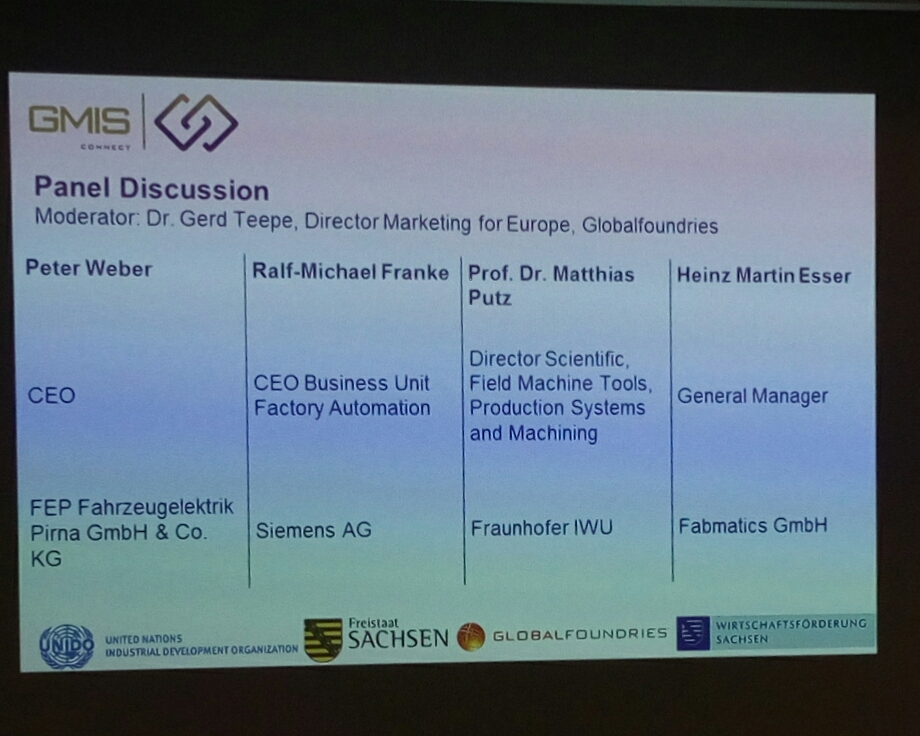
In einer hochkarätig besetzten Diskussion beleuchteten Vertreter von Fabmatics GmbH, SIEMENS AG Business Unit Factory Automation, Fraunhofer IWU sowie FEP Fahrzeugelektrik Pirna GmbH unter Moderation von Dr. Gerd Teepe, Director Marketing for Europe, Globalfoundries die Auswirkungen der Digitalisierung auf die sächsische Wirtschaft, sowie deren Chancen und Herausforderungen.


https://twitter.com/UNIDO/status/916240750446292992
Die Relevanz der digitalen Transformation und die internationale Vernetzung innerhalb der Wertschöpfungskette für die sächsische Wirtschaft betonte Stanislaw Tillich nicht nur in seiner Funktion als Ministerpräsident des Freistaat Sachsen, sondern auch als Ingenieur, der an der TU Dresden seinen Abschluss machte. Die anschließende Unterzeichnung des Memorandum of Understanding (MoU) zwischen der Wirtschaftsförderung Sachsen GmbH und der GMIS setzte ein weiteres Zeichen für eine künftige Zusammenarbeit zwischen dem Freistaat Sachsen und den Vereinigten Arabischen Emiraten.

Noch sind es knappe zwei Jahre bis zum nächsten Global Manufacturing and Industrrialization Summit in Russland in Jekatarinenburg, #GMIS19. Hinreichend Zeit für sächsische Unternehmen der Fertigungsbranche, sich mit anderen lokalen Unternehmen zu vernetzen und darüber hinaus die vielfältigen Möglichkeiten der sächsischen Forschungslandschaft, angefangen von der E3 Forschungsfabrik in Chemnitz, dem Smart Systems Hub und dem DLR Institut für Softwaremethoden zur Produktvisualisierung, Zentrum für Additive Fertigung Dresden (AMCD) und anderen aktiv zu nutzen.

Kurzfazit in Form des bewährten #PresencingStatus (ein Standardprozess der Reflexion, der aus Theorie U bzw. dem MOOC #ulab hervorgangen ist):

  • Good - einwandfreies WLAN; Veranstalter (GMIS & Globalfoundries) selbst auf zahlreichen Social Media Kanälen aktiv während der Veranstaltung
  • Tricky - kurze Anmeldungsvorlaufzeit (nicht 100%iger Rückmeldeprozess); kein Laptop dabei (Tippen auf dem Smartphone eine langwierige Angelegenheit)
  • Learned - die Vereinigten Arabischen Emirate haben bereits (auch im Industriekontext, wie Mubadala) die traditionellen Kommunikationsmethoden exponentiell erweitert (Twitter, Instagram, Facebook, Youtube);
    "Wir sind noch viel zu langsam! Egal was sie machen, tun Sie es zweimal so schnell!" - Prof. Dr. Matthias Putz, Fraunhofer IWU
    "Win-Win-Situationen möglich machen!" - MP Stanislaw Tillich;
    "How many people here are born in the 80's here? And 90's I'd assuming nobody?" - Badr. Al-Olama in seinem Abschlussstatement (niemand im Publikum ist in den 80ern geboren, vier Teilnehmer in den 90ern);
    "We [UAE] always ask ourselves:'Why not?' Not, 'Why should things happen the way they are?'" - Badr Al-Olama 
  • Action - aufmerksam nach wertschöpfenden Möglichkeiten und Verbindungen Ausschau halten, die eine Win-Win-Situation für den Freistaat Sachsen und GMIS darstellen und möglich machen
Ausgewählte Berichte über die GMIS Roadshow in Dresden am 6. Oktober 2017:


Social Media:


Tuesday, October 21, 2014

Graphen - Die "unsichtbare" Macht des Wandels

Fast auf den Tag vor drei Jahren fand am MPI-PKS (Max-Planck-Institut für Physik Komplexer Systeme) ein Workshop mit dem kryptisch lautenden Namen "Carbon-based Spintronics" statt. "Wer hatte schon zuvor (außerhalb der Wissenschaftsgemeinschaft und industrienahen Forschung) davon gehört?" - die wenigsten Bürger Dresdens wahrscheinlich (mich eingeschlossen).

Der öffentliche Abendvortrag am 28. Oktober 2011 (übrigens wie viele Vorträge und Vorlesungen öffentlich im Science Kalender Dresden zu finden) sollte mit einigen Überraschungen aufwarten.

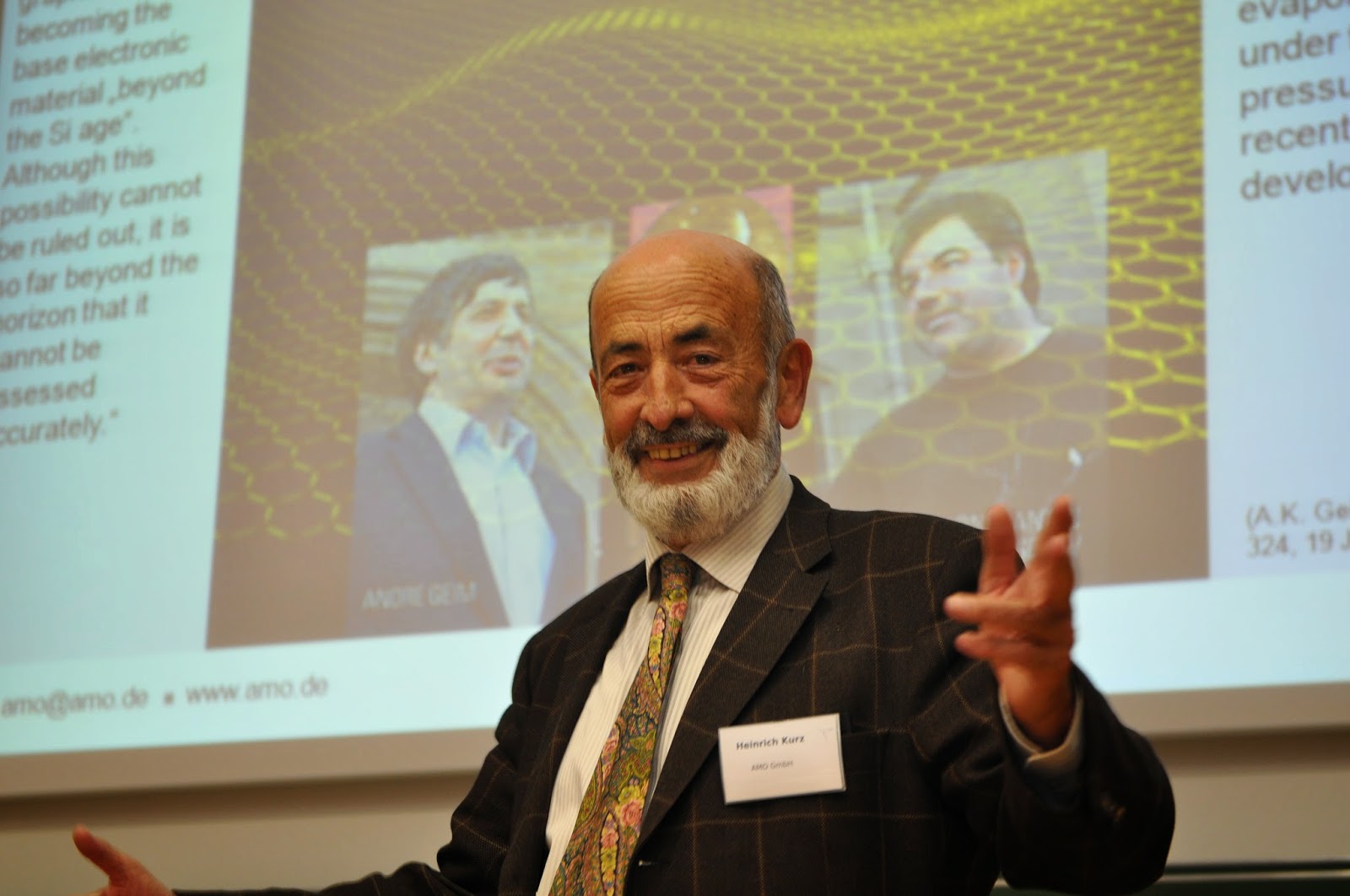
Prof. Heinrich Kurz (Foto von Prof. Gianaurelio Cuniberti)
Prof. Heinrich Kurz vom Institute of Semiconductor Electronics an der RWTH Aachen, GF der AMO GmbH, sowie designierter Leiter des Grapheme-CA [Graphene Flagship] versprach mit seiner Vorlesung "Graphen - Das neue Silizium des einundzwanzigsten Jahrhunderts?" einen aufschlussreichen Abend.

Einführend in das Thema des Abend war die erste Folie mit einer Darstellung von Moores Law (alle ca. 18 Monate verdoppelt sich die Anzahl der Schaltkreise auf einer gleichbleibend großen Chipfläche aus Silizium). Was damals zunächst wie ein Werbegag von Intel klang, um deren Konkurrenz zu verschrecken "bewahrheitet" sich als konstantes Paradigma. Erst ein Jahr zuvor hatte Ray Kurzweil, Futurist, Erfinder und Mitgründer der Singularity University auf dem 4. Dresdner Zukunftsforum davon in seinem Vortrag ebenfalls gesprochen.

Doch halt! Können wir den Implikationen für Wirtschaft, Gesellschaft und unser eigenes Leben, die sich aus diesem Paradigma ergeben überhaupt folgen? Zunächst werden derartige Entwicklungen stets unterschätzt (sowohl von der Öffentlichkeit als auch von den Medien - wer hat in den letzten drei Jahren in den lokalen Medien viel über "Moores Law" und "Graphen" gelesen oder gehört?). Kurz gesagt: unterschätzen wir (noch immer) die Zukunft?

Was mit der Erfindung des integrierten Schaltkreis und den Aktivitäten in Silicon Valley rund um die damals noch reichlich unbekannte Hochschule Stanford University (übrigens hervorgegangen aus einer privaten Stiftung) sich abspielte (sehr anschaulich in dem von Everett M. Rogers und Judith K. Larsen verfassten Buch "Silicon Valley Fieber" beschrieben) und den ersten "exponentiellen Steinwurf" in die Stille des "linearen Denkens" darstellte sollte noch übertroffen werden. Bereits 2002 wurde in einem Artikel in IEEE Spectrum [englisch] auf das Verschwinden des Transistors bei ständiger Miniaturisierung hingewiesen. Wo es genau hingehen (könnte) war noch nicht absehbar.

2004 war Graphen ("Wundermaterial" in Atomschichtdicke) von zwei russisch-stämmigen Wissenschaftlern entdeckt worden, die für ihre Entdeckung bereits 2010 den Nobelpreis für Physik erhielten. Seitdem hat das Interesse (innerhalb der Wissenschaft, weniger der allgemeinen Öffentlichkeit) an diesem "Wundermaterial" exponentiell zugenommen.

Ohne eingehender auf den Vortrag vom 28. Oktober 2011 einzugehen springen wir ins Jahr 2014. Wir schreiben den 20. Oktober 2014. Der Chiphersteller GLOBALFOUNDRIES, der auch in Dresden mit seinem Werk GLOBALFOUNDRIES Fab1 präsent ist gibt an diesem Tag bekannt, dass er die (verlustreiche) Halbleitersparte von IBM komplett übernimmt (Computer-Oiger sowie HTxA - HighTech x Agency und Silicon Saxony e.V. berichteten ebenfalls). Ebenfalls an diesem Tag veröffentlichte Peter Diamandis seine Gedanken zur Zukunftsentwicklung und Anwendungsfeldern von Graphen, die den wenigsten von uns bekannt sein dürfte im Wirtschaftsmagazin Forbes [English].

Doch was hat dies mit Graphen und dem Vortrag von Prof. Heinrich Kurz zu tun? IBM bereitet sich bereits auf die Nach-Silizium Zeit [englisch] vor und kann nun verstärkt Forschung in Richtung neuer Materialien, insbesondere Graphen, im Halbleiterbereich betreiben. GLOBALFOUNDRIES hingegen gewinnt durch den Deal die Möglichkeit entsprechendes eigenes Know-How in der Skalierung für neue Technologien (z.B. mögliche Integration von Graphen in bestehende Produktionsprozesse) einzubringen. Eine Win-Win-Situation aus volkswirtschaftlicher Sicht, können sich doch die Player auf ihre Stärken konzentrieren. Dresden gewinnt damit die Chance, die Forschung für zukunftsweisende Technologien auszubauen und angrenzende Anwendungsbereiche und Startup-Ecosystems entstehen zu lassen. Waren doch bereits 2011 acht (!) Institute an der Nöthnitzer Straße am südlichen Campusrand der TU Dresden mit der Forschung rund um die Nutzung von Graphen im Halbleiterbereich beschäftigt. Die Entscheidung von gestern sollte demnach weiteren Auftrieb für Forschung und Applikationsentwicklungen rund um Graphen bringen - auch und besonders hier in Dresden - nach sich ziehen.

Prof. Kurz schloss seinen damaligen Vortrag mit folgendem Vorschlag: "Ich schlage Ihnen vor, die Straße [Nöthnitzer Straße; Anm. der Verfassers] in Graphen-Straße umzubenennen!"

"Warum nicht?"


Thursday, September 12, 2013

Philipp Rösler pulling the Silicon Valley Spirit to Dresden

On Tuesday September 10, 2013 German State Minister for Economy and Technology, Dr. Philip Rösler had announced on Twitter his coming to Dresden, to discuss with Silicon Saxony e.V. (the cluster initiative of the microelectronics industry around Dresden) the impact and relevance of #Industrie4 at GLOBALFOUNDRIES Fab 1

Dr. Rutger Wijburg, senior vice president of GLOBALFOUNDRIES Fab 1 (Dresden, Germany), and Fab 8 (Malta, USA) mentioned in his welcoming speech to the crowd, made of several dozen representatives from education, business, politics, and to the media that the immanent role of microelectronics will be combining economics, and technology as a boundary object. There is no field in daily life which is untouched by microelectronics, making this field even more relevant in the future than it is already today.

State Secretary Hartmut Fiedler mentioned Minister Rösler's visit to Silicon Valley earlier this year, and also the visit of Peter Thiel (here video about his visit [German]) to Berlin on September 2, 2013 on Minister Rösler's invite. Together with mentioning his own visit with members of the Saxon State Government to the "Tech Valley" in upper New York State, where GLOBALFOUNDRIES Fab8 is located, it became quite clear in the room that "speed of innovation is not an option".

Helmut Warnecke, CEO of Infineon Technologies GmbH and vice president of Silicon Saxony e.V., emphasized in his presentation the relevance of the microelectronics for the industry in Germany, and especially its economic leverage potential for other downstream of the economic value chain. The prominent gathering of not only larger microchip producing plants and their suppliers but especially the closeness to the university research institutes, and Fraunhofer, Max-Planck, Leibniz-, and Helmholtz-Society institutes in the region around Dresden built on a legacy over a century in electronics. Since 1961 microelectronics has made the region the perfect place to foster innovations. Helmut Warnecke's quote "Is microelectronics everything? No, but without microelectronics is everything nothing" made clear what the emphasis of the meeting was: stating a clear commitment to the future relevance of this specific industry part in Germany.

With the most recent decision by SEMI International Association, San José, to split the most prominent trade fair about microelectronics, SEMICONEuropa, between the clusters in Grenoble and Dresden on rotating yearly basis, it became ever more relevant to hear what Minister Philipp Rösler had to offer.

Minister Philipp Rösler
Philipp Rösler pointed out his own recent experience with the startup scenes in Silicon Valley, London and Tel Aviv. He ensured the audience that German technology and entrepreneurial spirit bears the capacity to compete at highest levels with those other tech regions in the world. What he had seen however, especially around the example of Stanford, is the not yet fully used potential to create fast, and smoothly business models to transition from university (studies or research) to startups. Though the upcoming German elections lowered the impact of his words, he emphasized on the strong government will to keep the German-based complete value chain of microelectronics intact, and even thinks of bringing investor role-models like Peter Thiel or Marc Andreessen closer to the German technology and entrepreneurial communities.

His main points however, especially in respect to the big players in the microelectronics field in Germany, were on the EEG (Renewable Energy Sources Act). In its current version it's forcing energy prices to go up, harming energy intensive industries in their competitiveness with the world market. Which once was meant to accelerate the renewable energy production has led to a misallocation of money. His second focus point was on making the startup conditions for entrepreneurs and innovators in the "non-apps world" easier in Germany, not only on the financial side (which some voices from the audience were drawing attention to) but also on the surrounding conditions. These are by far, concerning transparency, speed, interdisciplinary, not similar today to what can be observed in Silicon Valley, which btw also started very much as largely public project funded.

In the follow-up public discussion financing issues for scaling startups, and the lack of a viable, and visible VC capital (venture capital) scene especially in Saxony came up. These questions could not be answered in this round, but set a clear signal. Silicon Saxony as the main European hotspot in microelectronics, including adjacent fields like nanotech, life sciences, computer science, and organic electronics has the potential to reach up to the envisioned future by enabling the entrepreneurial spirit to flourish in the region once again.

Ralf Lippold

Tuesday, May 14, 2013

Saxony - A True Global (Emerging) Attractor


Saxony establishes itself as an immigration country - best saldo since 1995

Saxon State Minister for Economic Affairs, Labour and Traffic, Sven Morlok, presented on 2013-04-25 during a press talk at GLOBALFOUNDRIES Fab 1 the most recent developments of the immigration status (from inner Germany, and abroad) towards Saxony. The meeting also took the chance to gratulate Mr. and Mrs. Trepte a couple with Saxon origins that relocated to Saxony, after working three years in Schleswig-Holstein and in 2012 both relocating to Saxony, and working at GLOBALFOUNDRIES Fab 1 now.

The positive overall message that emerged from this morning on the edge of Dresden is that Saxony attracted more people in 2012 (triple the number of 2011) to move into Saxony than Saxons moving out of the state. This is especially valuable in times of the developments of overall workforce (in the tradional sense employment) due to aging demographics.

As the presented data (presentation, in German) showed the strongest inflow of people into Saxony had been from outside German. This indicates the rising awareness of the attractiveness of the region in the world on the one hand, especially in the hightech arena. On the other hand other economic dynamics in the Southern parts of the European Community, and Eastern Europe fall into place.

The cities Dresden, Leipzig, and Chemnitz which have drawn in the most incoming people, and their saldo is mostly positive, are thriving economically. Quite different is the situation on the edges of the Free State of Saxony such as the Ore Mountains, or the Lausitz region that still face a braindrain even though their industries are at high levels of quality.

Several questions by other press members in the round at the end of the presentation made clear that a deeper distinction of the returning people (presently a large number of incoming people is due to students starting their studies at of Saxony's universities), and the intentions of them may lead to further insights on acting towards future labour incentives in Saxony.

Concerning the question on the overall impact of the significantly lower transfer payments by European Community, and the finish of the Solidarpakt II in 2019 State Minister Sven Morlok drew attention to the newest report by ifo Dresden from 2012. He also mentioned that the impact on BIP (Brutto Inland Product) due to this development will be between -0.5% and -1% for Saxony (as stated by a recent research study by ifo-Institute Dresden, ifo Dresden berichtet, from page 21 on, in German)

This drew out another question on whether a specified model of an X PRIZE for job creation as proposed by  Peter Diamandis in the Huffington Post could be put to action in Saxony to not only create jobs, but also draw interest towards Saxony on global scale. At the same time enabling local companies, and uprising startups to generate future economic, wealth, social, eduction, and business innovations that once were famous for Saxony.

Saxony clearly has advantages in comparison to other regions in Germany, even though being on the edge, and only more recently capturing rising global interest. GLOBALFOUNDRIES and other internationally active, and connected players give a more than positive sign on which to build on in the coming future.

May the region further strive, and take the chance of diminishing public funding streaming into Saxony as the driver for lasting economic wealth creation across all disciplines, and levels of business.

Ralf Lippold

Wednesday, March 14, 2012

GLOBALFOUNDRIES edging towards 20nm

Dresden, 2012-03-13 #DATE12

Mojy Chian, Senior Vice President Design Enablement at GLOBALFOUNDRIES, and Antun Domic, Senior Vice President and General Manager of synopsys gave a short press conference on the sideline of the ongoing DATE12 (Design, Automation & Test in Europe) this evening for a multinational press audience.

The main topic was the past and ongoing cooperation between the two companies, especially the  implementation of the forthcoming 20nm-technology, to be expected roughly coming to mass production around 2014, as Mr. Chian mentioned. He also mentioned, that cycles of new technologies roughly being in a 4-year-frame, with CPU producers being the earliest and most demanding customers, next to following mobile application producers. In order to get the ramp up smooth and in accelerated pace, once the technology is set for mass production the cooperation with chip designers, and testing facilities such as synopsys are essential. From the technology information given by the customer the design phase (including testing) is the most relevant part in the value chain, before manufacturing in large scale can begin.

Presently roughly 500 engineers work at GLOBALFOUNDRIES -scattered all around the three plants in Malta, USA, Dresden, Germany, to Singapore, and other facilities around the Globe- using remote work environments using the virtual collaboration tools the Web provides (and in which often chips from GLOBALFOUNDRIES can be found). The aim is, as Mr. Chian and Mr. Domic stressed to work on more and more standardized information technology formats, in order to make automated design, and testing easier. "As there are 1.001, no 1 Mio + 1 things to be in place", Mojy Chian mentioned, and almost made the room laugh, "it is crucial to work to together early on in the process."

EUVL tool, Lawrence Livermore
National Laboratory
(Wikipedia)
During the hour there came up the question on whether the EUV (Extreme ultraviolet lithography), which opens future chances, yet brings along quite some challenges that are not easy to overcome in short time, so it will not be applied for the forthcoming 20nm-technology, as Mr. Chian pointed out. He also stressed, that in context of the ongoing collaboration with synopsys "the amount of creativity what has been applied has been incredible", and there will be routes to be found that will tackle the upcoming challenges.

What we all could take from that hour is that chip design & manufacturing clearly define a next level in collaborative iterative learning, as ramping up of new production nears, and GLOBALFOUNDRIES and synopsys could very well be new role models in the context of "Lean Thinking".